

Four ways into your AI feature will not get you four times the adoption. It usually gets you no habit at all.

Most of the tools I reach for every day turn out to be interesting once you look at them properly. Dia is one of those, and I use it daily.
Its lead designer is Charlie Deets. I ended up watching a long interview with him on Dive Club, and several things I had liked about Dia without being able to explain suddenly got a lot clearer.
AI can do so many things that teams keep adding a new way in for each of them. This issue is about why that rarely produces a habit.
Four entry points, not four equals
Dia has several ways to reach AI. The important decision is that it does not treat them equally.
The address bar is the primary surface. The others handle more specific jobs around it.
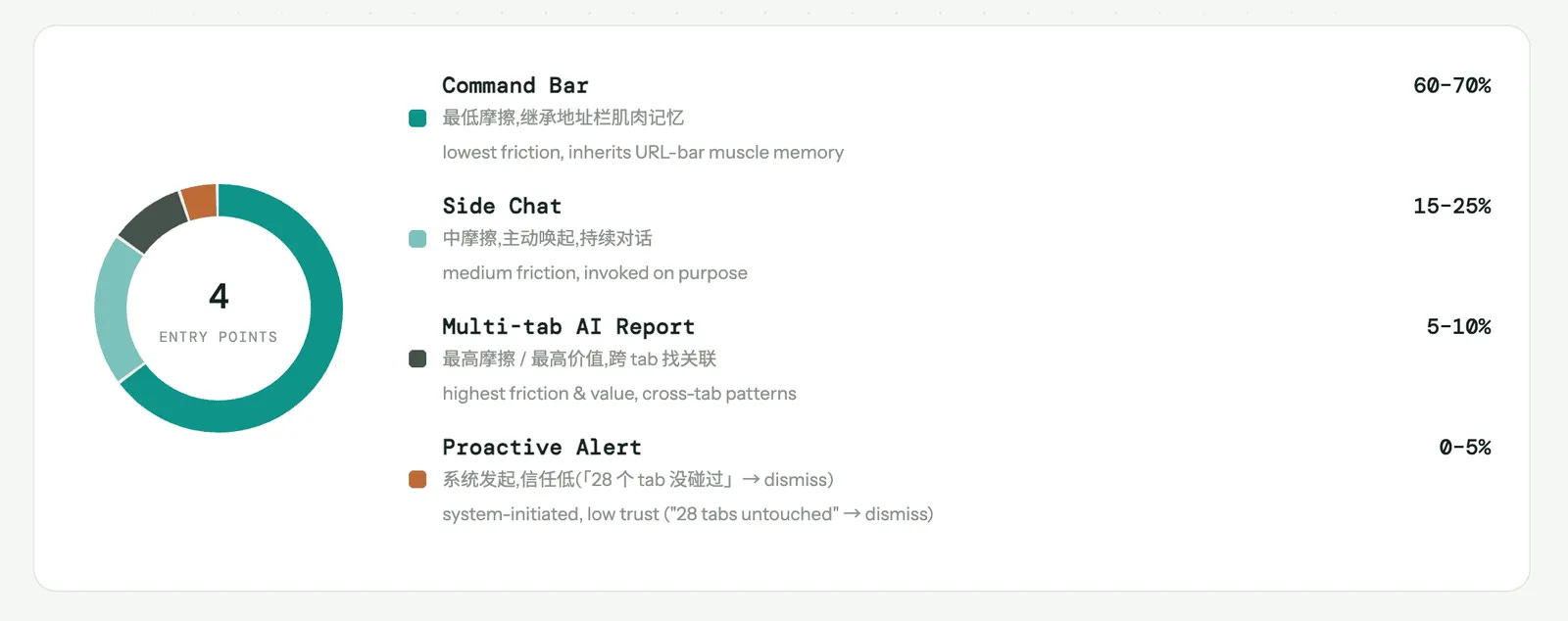
That looks minor and I think it will turn out to be a lasting pattern. Because AI can perform so many tasks, the tempting move is to give every capability its own door. You end up with several usable surfaces and no strong habit around any of them.
Cursor, Linear and Dia all do the same thing. Find the most frequent and natural way in, concentrate investment there, and let the supporting surfaces take the specialised cases.
Four surfaces competing for equal attention rarely create a clear habit. One strong front door, with the rest organised around it, usually does.
Where does the saved attention go?
There is a second question underneath this one, and it is the more useful of the two.
Once a team has lowered the cost of learning its product, where does the attention it freed up actually go?
Plenty of products get simpler and cleaner without helping anyone reach the core value any faster. Complexity drops and so does the thing that made them distinctive. Simplification without a destination is just deletion.
Dia avoided that. It cut the effort Arc’s original concepts demanded, then spent the space it created on AI. Josh Miller has published two figures: chat-with-tabs reached 40 per cent of daily active users, and personalisation reached 37 per cent.
Those are among the few public usage numbers for Dia, and they suggest the AI became a real part of the product rather than a demo attached to it. Compare that with Arc’s own signature features, where multiple Spaces reached roughly 5 per cent.
One note that sharpened this
Removing a door changes behaviour more than adding one. I deleted Twitter and LinkedIn from my phone a week ago. Not a detox, just a practical change so the small screen stopped being the first thing my brain processed each morning.
Seven days later: a full product review finished, client work delivered on time, consistent training sessions, more output with noticeably less end-of-day exhaustion. I had badly underestimated how much was being burned before I opened my first task.
I did not go cold turkey either. Two fifteen-minute windows a day, on a laptop rather than a phone. The feeds still got read. The number of entrances was what changed.
Try this on your own product
Name your primary surface. Not the one you wish people used, the one they actually reach for.
Then look at every other way into the same capability and decide what specific job each one does. If you cannot say what a surface is for in one sentence, it is probably competing with your front door rather than supporting it.
And if you have simplified something recently, check where the attention went. If it did not get spent on the capability that matters most, you did not simplify. You deleted.
Also from me
A few other things I have written, outside the teardown.
Make things the way musicians make singles
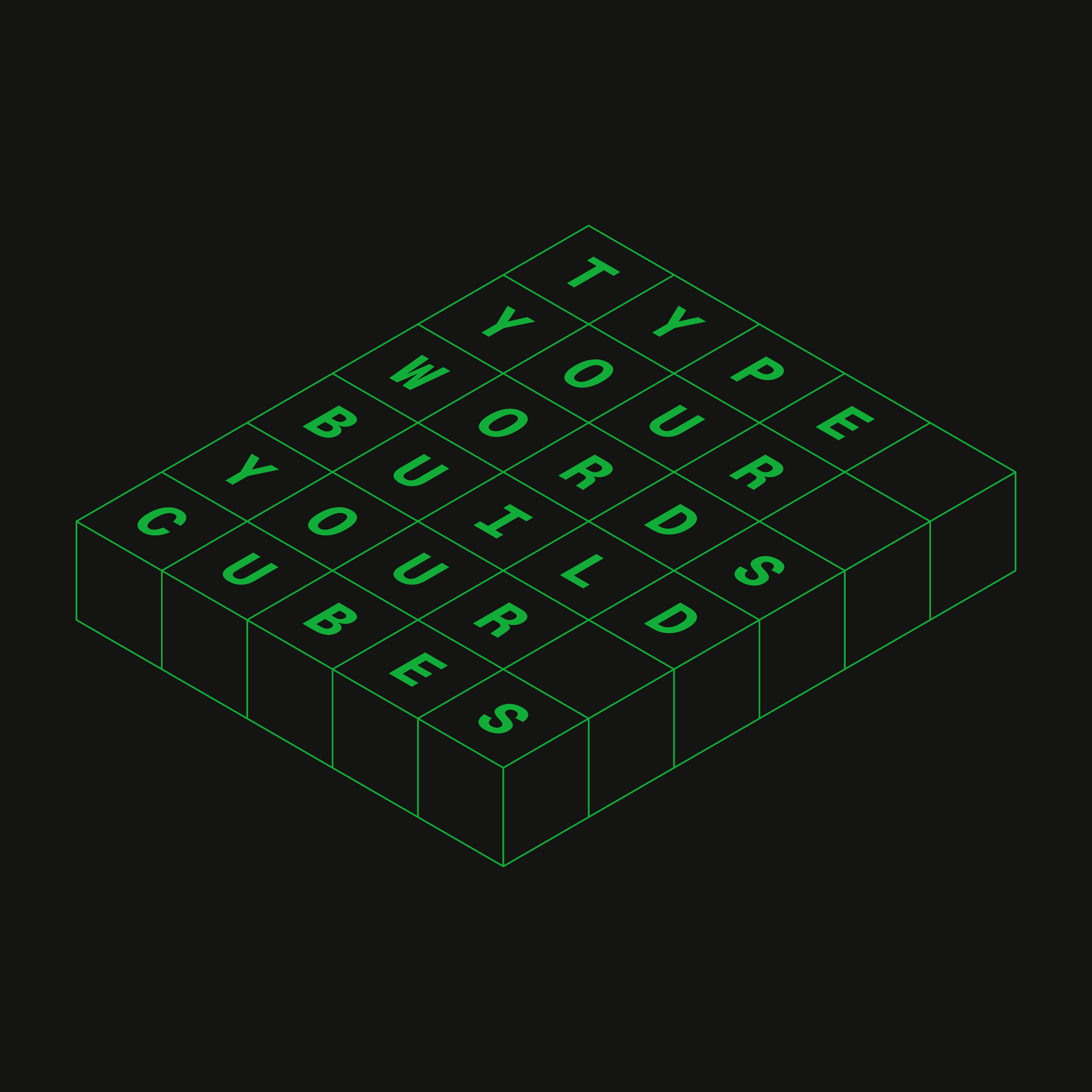
I made CUBE TYPE because of a note I wrote to myself in August.
The note said: designers and developers should make things the way musicians make singles. Not portfolio pieces. Not side projects angled toward clients. Just a small, finished thing that shows what you can do, what you care about, and what you have been thinking about lately.
The music analogy landed for me because singles are not auditions. They are statements. A musician drops one every few months and you know immediately where their head is at.
Most creative people I know wait for a brief, a client, a reason. The work stays inside them, unexternalised.
Making CUBE was me testing whether I actually believed my own note.
I think I do.
The box is the screen now
I used to think “thinking outside the box” was about creativity.
Then I noticed the box had changed. It is not a room or a job or a habit anymore. It is the screen itself. Every feed, every recommendation, every notification is still a pipe. And we are inside it, experiencing the world through it, mostly without realising.
The thing I keep coming back to is bookshops. Before algorithms, you walked in not knowing what you would leave with. Someone else’s dog-eared copy on the wrong shelf. A cover that stopped you. A recommendation from a stranger at the counter. None of it was designed for you.
That randomness was not inefficiency. It was the outside of the pipe.
The most interesting ideas I have had this year came from conversations that no feed would have served me.
Thirty minutes of competitor research, with the judgement kept
Competitor research used to eat half my day. Now it takes about 30 minutes, and the output still goes straight into a client deliverable.
Here is the part most people get wrong: you do not hand your judgement to AI. You delegate the screenshotting and the copy-pasting. You keep every call that matters.
The workflow has three layers. Mobbin sources real, shipped product screens. Claude structures the patterns across them. And you, the human, choose which competitors are worth studying, pull comparators from other categories that solve the same job, and decide what the gaps actually mean for the client.
One boundary worth saying out loud: this is secondary, observational research. A pattern-and-gap inventory of shipped products, chosen by a person, not scraped. It is not user-validated insight, and it never replaces talking to your users. That honesty is exactly what makes it defensible client work.

Where to next
The full Dia teardown is on the site, including the moving list from Arc and why a $610 million acquisition still does not settle the product-market fit question: bearliu.com/blog/dia-the-budget-transfer
Which surface is your real front door? Hit reply and tell me. I read everything that comes back.

Hello, I’m Bear.
I’m a product designer in Auckland, New Zealand. Most of my work is as a Fractional Design Partner, which usually means being the design lead a small team cannot yet hire full time.
Design Decisions is where I take one product apart each week and write up the decisions behind it. I make videos and record a bilingual podcast for much the same reason. I like working things out in the open.
bearliu.com · the full teardown library, and what I do for teams
hi@bearliu.com · the old fashioned way, and I read every reply
youtube.com/@Bearliu · a video is worth a thousand words
x.com/bearliu · shorter thoughts, as they happen