

This newsletter went quiet for a few months. The honest reason is that I could not answer a simple question about it. Who was it for, and what was it about?
I have an answer now. It is back, it is much narrower than it used to be, and it has a new name. If you subscribed to this as Bear Academy, you are in the right place.
Design Decisions is about the choices behind digital products. The question is rarely whether a product is good. It is what a team decided, what they gave up to get it, and which constraints they were working inside. The main format is the product teardown. I pick a real product, use it properly for a few weeks, and take it apart in public.
Teardowns earn that place because they are the one format where the decision is still visible. A case study shows you the outcome after the fact. A teardown lets you reason backwards from the interface to the choice that produced it, and the choice is the part you can reuse.
If you are building something early, this is written for you. Founders, designers, product managers, engineers, people working alone or in small teams. What you have in common is that you are deciding before all the answers are in.
Here is the kind of thing that turns up.
Apple asks you for almost nothing. Google asks you on every screen.
I spent three weeks wearing a Fitbit so I could study Google Health properly, with Apple Health as a control.
Most of what lands in Apple Health arrives on its own. The Watch and third-party devices write in the background, and the app rarely asks you anything at all. It does not chase feedback or check whether a recommendation helped.
Google Health does the opposite. Open it and the AI coach may comment on last night’s sleep, a recent workout or a change in your heart rate, then ask how you feel about it.
I asked mine what my resting heart rate actually meant. It pulled thirteen days of my data, showed a range of 59 to 68 beats per minute, drew a chart I could inspect day by day, and backed the explanation with external health sources. Then it asked me something back: does that overview give you the peace of mind you are looking for? When I mentioned I was taking heart medication, it carried that into the next reply. When I switched to Chinese halfway through, it followed.
As a piece of interaction design, the coach is genuinely well made. The more interesting question is why it is so eager to keep the conversation going.
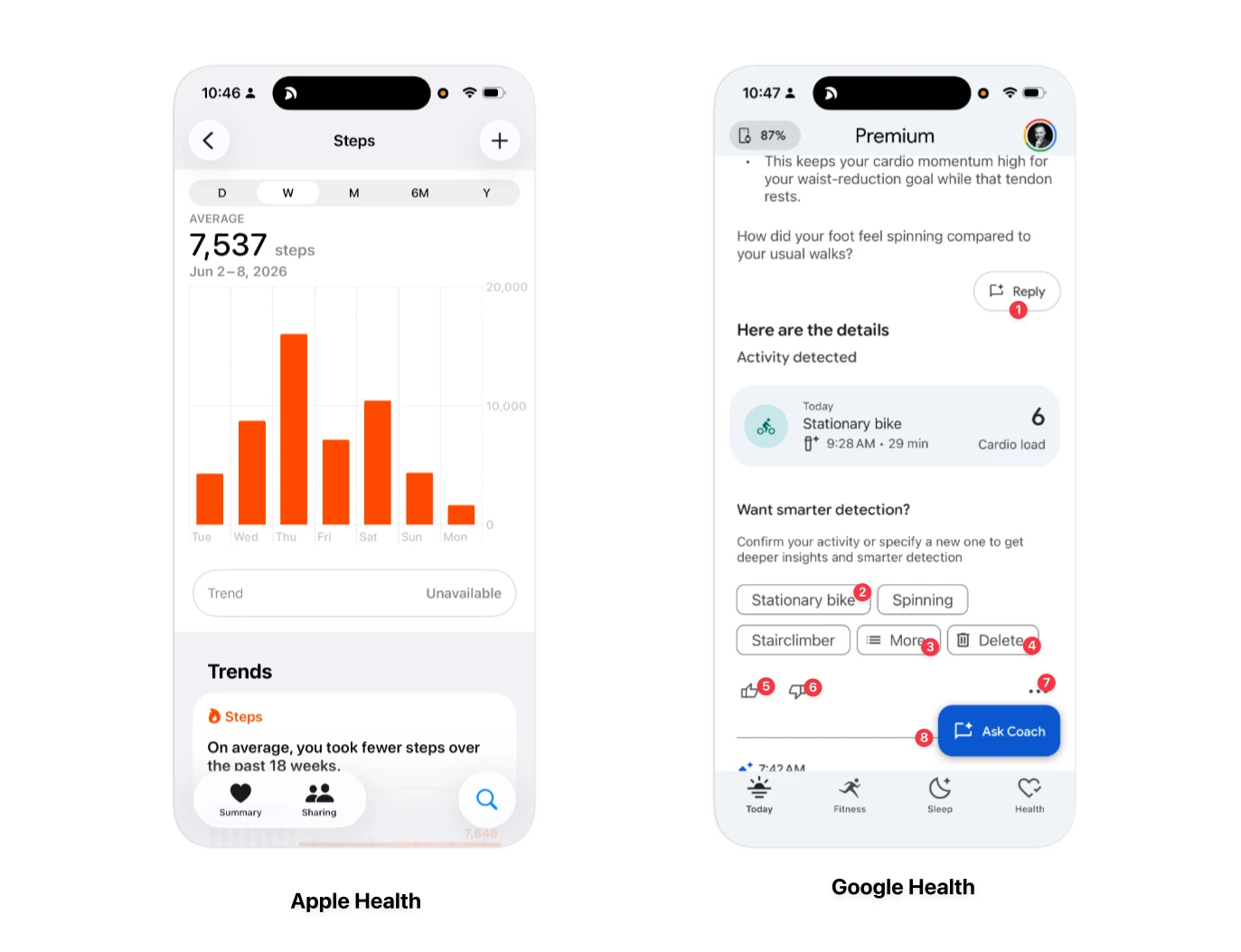
My first instinct was to grade them. One of these had to be the better design. That instinct was wrong, and correcting it was the most useful thing I took from the whole exercise.
Apple’s health strategy runs on the iPhone and the Watch. It needs you to believe that years of sensitive records can sit safely inside its ecosystem, because that trust is part of what keeps you buying the hardware. Fewer questions, fewer interruptions and more on-device processing are not restraint for its own sake. They are part of the offer.
Google’s strengths were built around data and machine learning. Health data carries tighter restrictions, and Google says it does not use it for advertising. It still needs behavioural feedback to improve its products and its models. So a good coach does two jobs at once. It helps you understand your body, and it collects the kind of signal a passive tracker can never reach.
Same job, same data, opposite interfaces, and both of them right.
Try this on your own product
Take your most visible design choice. The free tier, the constant prompt, or the thing you pointedly refuse to ask users for. Read it back to how you make money. Does it hold up as a business decision, or only as taste?
Then the harder version. If a competitor copied that choice without your revenue model underneath it, what would it cost them?
What happens from here
One issue a week. One question about how a product got its shape, and one thing you can take back to whatever you are building.
Six complete teardowns are already on the site, each with the full argument and the screens attached: Apple Health, Google Health, Linear, Arc, Dia and Raycast. The two behind this issue are The Restraint of Apple Health and Why Does Google Health Keep Asking You Questions?
If something you are building runs into this, hit reply and tell me about it. I read everything that comes back.