

I have started using a walking pad under my desk. I resisted it for a long time. Work meant typing and clicking all day, and both want a steady hand. Standing on a moving belt while doing that sounded like adding cognitive load for no good reason.
It turns out most of my day no longer needs that precision. Voice input handles a lot of it now, and a great deal of the mouse work is a single click rather than a careful drag. The constraint that ruled the walking pad out had quietly stopped applying.
Maybe half the day still needs a steady hand, and that half is the part I enjoy most. Worth noticing. When the tooling changes, what is left standing is usually the part that was the real work all along.
Ask a product team which features matter and most of them will say all of them. Ask the same team to rebuild from scratch and the answer gets honest very quickly.
The Browser Company gave that answer in public. Arc never broke through, and never held more than 0.1 per cent of the browser market. Dia, built by the same people, launched in June 2025, and three months later the company sold to Atlassian for $610 million. What changed between the two products is a list, and the list is the useful part.

The moving list
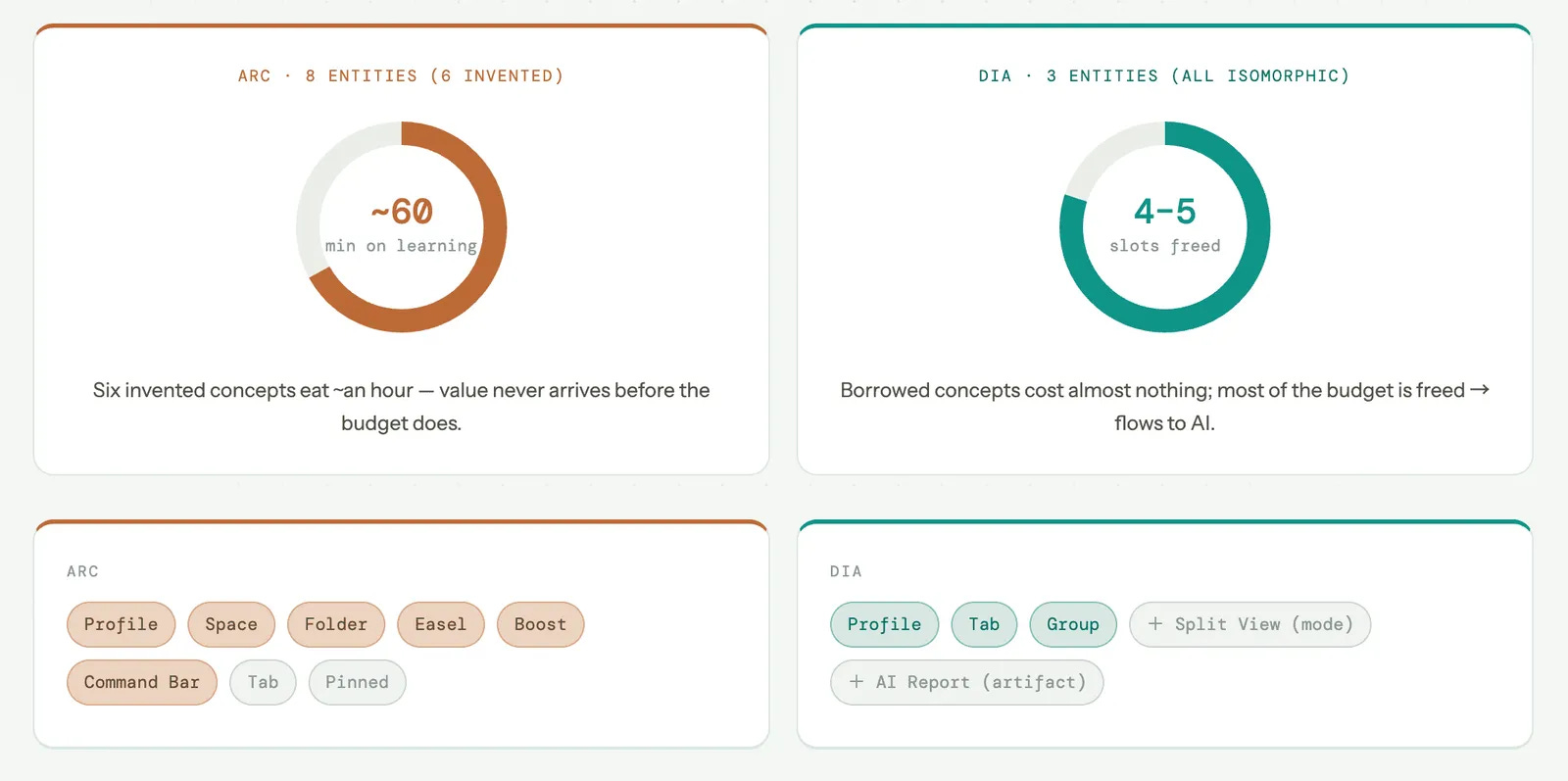
Arc asked a lot of a new user. Profile, Space, Folder, Easel, Boost, Command Bar, Pinned Tab. Tabs and pinned tabs needed no explanation. Almost everything else was invented, and each invention arrived with its own logic.
Every one of them had a reason to exist. Put together, they stopped being a set of features and became a new product language.
Attention is the budget here. Say someone will spend ninety minutes in their first week working out how a product behaves. Six invented concepts at ten minutes each eats most of that. By the time they reach the part that makes the product worth switching for, the patience has gone.
When the team rebuilt as Dia, they carried the Command Bar, Split View, the sidebar structure and the tab lifecycle that quietly archives what you stopped using. They left Spaces, Folders, Easel and Boost, along with several of the AI features added late to Arc.
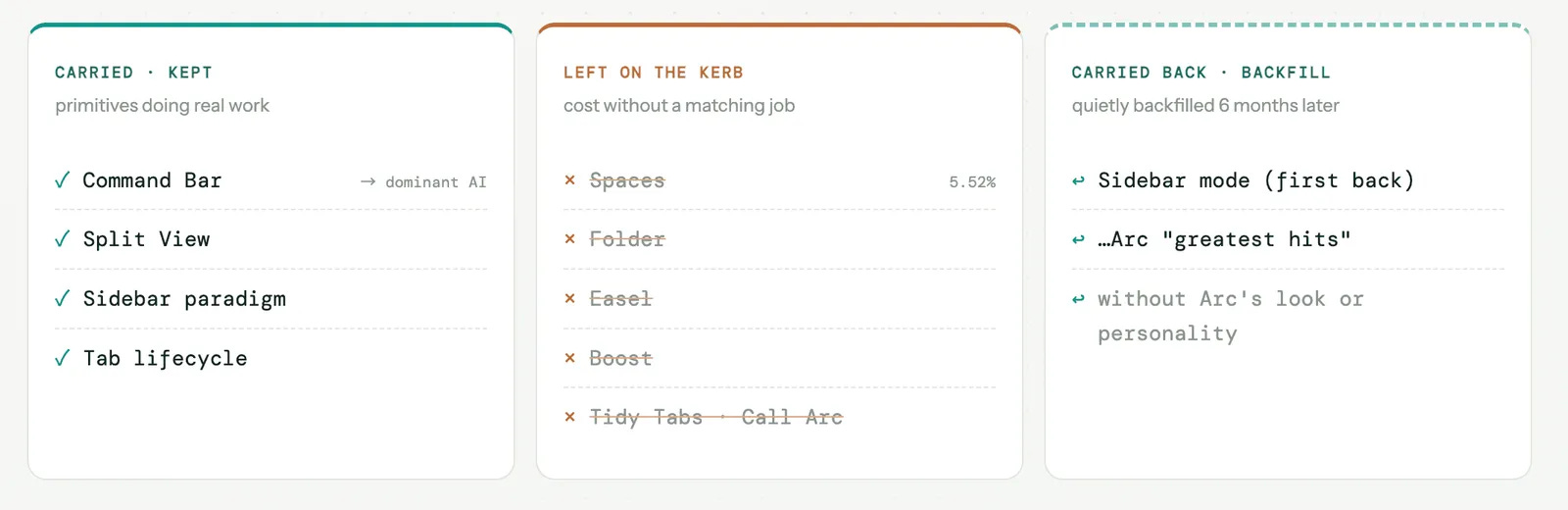
The Command Bar is the one that matters. In Arc it had already become the single place you expressed intent: open a page, search, run a command, ask something. Dia kept it and made it the main way you reach AI. It has now survived two generations of the same team’s thinking, which is about as strong a signal as a product asset can give you.
Read the list twice
There is a second list, and most people stop before they get to it.
Around six months after launch, Dia began bringing Arc features back, starting with a sidebar mode. Some things had been cut too fast.
So a moving list is worth reading twice. What survives the rebuild tells you what a team believes is core under pressure. What comes back later tells you where users actually felt the value. The gap between those two lists is where the first judgement was too aggressive.
You can run this without a rebuild. Asking a team what is not working invites explanation and defence. Asking them to keep only half forces a ranking, and the ranking is what you were after.
Two notes that sharpened this
Most products lose people before the value arrives. The gap between someone’s first interaction and the moment they think this is worth my time is a growth variable, not a soft UX concern. Two habits quietly widen it: the feature tour, which asks for trust before giving a reason to trust, and configuration friction, which bets on willpower instead of product quality.
Arc’s ideas were not bad. The bill for learning them simply came due before the payoff did.
Subtraction is the skill. A good illustrator strips reality down to the fewest marks that carry the idea, and the deciding is where the craft lives. Early teams often have the opposite instinct: more features, more onboarding steps, tooltips explaining the tooltips. The product ends up a detailed sketch of everything the team knows rather than a clear signal of what a user needs to see right now.
Try this on your own product
If you had to rebuild tomorrow and could keep only half of what you have, which half survives?
Write that list before you look at your roadmap, so the roadmap does not answer for you. Then ask the harder second question. Of the things you would cut, which would users ask you to bring back within six months? If you cannot answer that one, you may not yet know where the value is actually felt.
Where to next
The full Dia teardown is on the site, including why a $610 million acquisition still does not settle the product-market fit question: bearliu.com/blog/dia-the-budget-transfer
If you have run your own moving list, I would like to see it. Hit reply and tell me what survived.